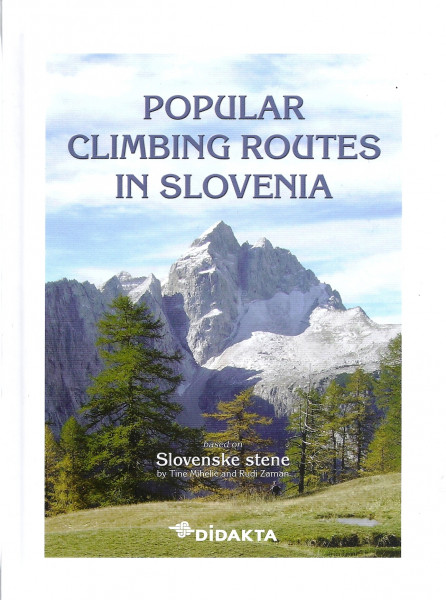
Product information "climbing guidebook Popular Climbing Routes in Slovenia"
For quite some years the authors carried the climbing guide Slovenske stene (from which this book, Popular Climbing Routes in Slovenia, has been prepared) within their hearts and minds. But young alpinists wanted to have a survey of the finest routes and mountain walls throughout Slovenia, and so the guidebook came into being in 1987, followed by a second edition. Foreign alpinists have often pointed out how good it would be to translate this book and thus present the best routes to climbers from abroad who wish to spend some time exploring the Slovene Alps. The choice of routes in the original book was governed by three criteria: aesthetic (the most important), historical and regional, and many alpinists were involved in the selection. Sadly, the author Tine Mihelič died in the Slovene mountains in 2004 and it is in his memory that this selection of the best known climbing routes in Slovenia has been prepared in collaboration with the two translators. 332 pages / hardcover language english edition 2014
The history of climbing in Friuli Venezia Giulia is one of the most important in Italy, since it arises from the careers of mountaineers the likes of Comici and Carlesso, who “invented”, out of the blue and in the first decade of 20th century, Val Rosandra and Dardago as a playground where it was possible to train for more ambitious tasks in the Dolomites.
This area, which can be roughly divided into three different sections, features several charming and testing crags and walls, well-suited both for the beginner and for the pro.
It includes the renowned overhangs of Erto, the small crags of the local Dolomites, the Tarvisio and Carnia walls; Trieste is also reviewed and carefully described: its famous crags such as Costiera and Napoleonica are of course featured in this book.
Then, we have “the other side”, just across the border. Osp, Mišja Pec and Crni Kal are well-known all over Europe. Once they were mostly forbidden, but right now they are destinations for every climber in Europe.
This second edition of a comprehensive guidebook has been born thanks to the collaboration of an active community, whose members do believe in promoting and sharing the beauty of their lands.
432 pages
language italian
edition 2020
D. Bucco
Versante Sud
The Publishing House of the Alpine Association of Slovenia (PZS, a UIAA full member) has released a new guidebook: Moderne večraztežajne smeri (Modern Multi-pitch Climbs) by Andrej Grmovšek and Viktor Relja. It’s the first of its kind in Slovenia and all the essential information is provided not only in Slovenian but also in English.Andrej Grmovšek and Viktor Relja have compiled 300 routes on 69 rock faces of the Slovenian Alps, ranging from 4b to 8a+ and up to 700 metres in length.All of the routes in the guidebook are either partially (at least the belay stations) or fully bolted, but they differ in difficulty, length, and commitment. “This is the first guidebook of its kind in Slovenia. Although some of these routes have been around for quite a while, many new climbs have been bolted in recent years, which was one of the reasons we decided on this project. We started working on it about two years ago and the intensity ramped up in the last ten months,” said the editor, Marta Krejan Čokl.The authors of the new guidebook, Andrej Grmovšek and Viktor Relja, are well-known figures in the Slovenian climbing community. Andrej has been climbing for over thirty years and doesn’t plan to stop anytime soon. After having done numerous difficult routes all over the world, he’s recently focused his energy on exploring the lesser-known walls of Slovenian mountains. His usual climbing partner is his wife Tanja, herself an excellent climber. Viktor has also climbed a lot with his wife Suzana; together they’ve opened almost two hundred routes, two thirds of which are fully equipped. They’ve left their mark on mountains outside of Slovenia as well.This guidebook aims to provide an overview of Slovenian rock faces to climbers at home and abroad, as all the essential information has been translated into English. “There are plenty of guidebooks for Slovenian sport-climbing crags, but there hasn’t been a compilation of bolted multi-pitch routes in the mountains. Such guidebooks are very common in other countries. Until now, Slovenia was the only Alpine country without a guidebook for the so-called Plaisir routes. I hope that our book will fill this gap. It includes equipped routes of all grades on good rock, which are accessible to a wide variety of climbers. It provides a useful overview of many routes throughout the Slovenian mountains,” explained Viktor Relja.The faces in the guidebook are ordered from west to east. All routes are marked on photos and there are topos for the more complex ones. The details of routes are displayed using symbols, making route-finding a breeze. The trailheads and starts of routes are marked on maps, and GPS coordinates and QR codes are also provided.Modern multi-pitch routes and sport-climbing are becoming increasingly popular in Slovenia. “Many of the Slovenian rock faces are characterized by poor rock quality and a lack of features, which makes them largely unsuitable for this type of climbing. This guidebook includes pretty much all of the bolted, modern multi-pitch routes in Slovenia,” added Andrej Grmovšek.
386 pageslanguage: slovenian, englishedition 2024V.Relja, A, GrmovšekPZS
The topo guide is dedicated to bouldering along the Soča River near the village of Trnovo ob Soči in Slovenia. The boulders were discovered by Gašper Bratina, who, together with climbers from the Gorica region, began cleaning and climbing them back in 2009. Today, the bouldering area offers more than 1000 high-quality problems, some of which are still untouched and waiting for the strongest boulderers. An expanded version of this guide can also be expected in the future, as potential boulders and even sectors are still being discovered.The bouldering guide took shape in 2020, when Slovenia was hit by the coronavirus epidemic and was confined to its home regions. During this time, the author explored the routes / problems, searched for new boulders and arranged their landings. He noticed how extensive, high quality and beautiful the area is. By creating this bouldering guidebook, he hopes to contribute to the development of bouldering and introduce it to a wider audience in this part of Slovenia.232 pagesLanguage Slovenian, EnglishEdition 2024A. Gregorcic
The 2025 edition is here! 6 new areas have been included in this climbing guide.
A new, revised and updated edition of the sports climbing guidebook to the Slovenian climbing areas includes over 6500 routes in 113 climbing areas. It rounds up all the sports climbing possibilities from the Mediterranean area, including Osp and Mišja peč, to the alpine regions of the Julian Alps and the hills of the Slovenian north-east.Many hand-drawn crag topos have been replaced with photos, which often make finding the desired route much easier. But state-of-the-art paintings by Danilo Cedilnik – Den, an experienced Himalayan climber, alpinist, and painter, remain our trademark.One of the great attractions of Slovenia is how small and compact it is. The sea and the Karst, the Alps and the Pannonian plains – all of them are just a couple hours’ drive away, even if it means driving across the whole country. This makes Slovenia a climbing destination par excellence and a place where you can climb throughout the year. From the crags in the high Alpine areas and the walls tucked away in cold forests where you can climb during the heat of the summer, to the yellow tufas near the sea where you’ll be wearing short sleeves in the depth of winter, while other people are skiing and climbing frozen waterfalls less than two hundred kilometres away… All of this and more will be right at your fingertips.688 pages Language: Slovenian / Italian / German / English edition 2025 D. Cedilnik Sidarta
- Warning: Increased shipping costs due to book weighing more than 1kg -
Climbing in Croatia (except Paklenica) This definite guidebook for Croatia (except Paklenica) in its 10th edition offers a total of 76 climbing areas and over 3600 routes. The guide includes all equipped climbing areas and walls along the Adriatic coast, as well as the most interesting areas of the inland. Each area is described in an introductory text about its main features, accommodation and access to the area. All other information - number of routes of different grades, route lengths, access times, GPS data, orientation/sun, climbing styles, wall characteristics, best season, child-friendliness - are clearly presented in pictogram form. The guide is trilingual throughout - at the beginning of each crag there is a description in Croatian, German, and English. Conclusion: very good guide, very rich in content.
Described areas: Split and the islands of Hvar, Brac & Vis; Istria region, which covers the area around Pula, Rovinj & Pazin; Areas around Rijeka & Karlobag; Areas around Zagreb Rock: limestone Difficulties: predominant 5th, 6th and 7th grade french scale / single and multi pitches Protection: mostly sport climbing conditions Season: all year round 720 pages Language: Croatian / German / English 10. edition 2024 B. Cujic Astroida d.o.o
- Warning: Increased shipping costs due to book weighing more than 1kg -
In October 2019, a new edition of guidebook for Istria and Kvarner was published. This time it's even larger and richer, with additional areas of Gorski Kotar and islands: Vela Peša, Golubinjak, Vrbovsko, Antovo, Portafortuna, Belove stene, Baška, with drawings for Lubenice, Babina, Osoršćica and Lukovo. As always, we try to make each edition better and more useful.
The new guidebook now has 36 crags and over 2000 routes. All other crags have been updated, freshly photographed and checked: Kompanj, Krkuž & Balcony, Čiritež, HC, Nugla, Raspadalica, Pandora, Buzetski kanjon, Kamena vrata, Istarske toplice, Čepić, Ponte Porton, Pazin, Dvigrad, Limski kanal, Rovinj, Vinkuran, Rabac, Brseč, Moščenićka draga, Medveja, Vela draga, Kanjon Rječine, Veli vrh and Kamenjak.
The guidebook now has a more durable cover with useful ribbon, which will come useful, as the book has grown to 464 pages. Anyone who feels the book is too heavy to carry under the crag, will surely appreciate that the price includes a free of charge Vertical Life app, with which you will get all the crags in the book on your mobile phone.
As you’re already used by now, the guidebook precisely, informatively and with a pinch of humor covers all the crags in the region, with updated grades and lines of routes, out of which everyone is marked on photo topo, often from multiple angles. Guidebook combines panoramic-drone shots from afar with super practical DOFAP photos from under the wall, which is the situation you will see as a climber, seeking your route.
The book also has lots of informative texts about history, gastronomy and nature, along with climbing tips, interviews with prominent climbers and funny stories to pass the time. It’s all completed by many great photos and ticklists of routes at the end. And let’s not forget about the rest day section with tips what you should see and experience when you’re not climbing.
The new layout will please people with poorer eyesight, as the fonts are much bigger, as well as the intro page and photo topos. The crag description has some useful icons, followed by overview of the weather conditions, style of climbing, comfort for children and safety and suitability of the crag with tips for different levels of climbers. Sometimes there’s some space left for a historical tidbit or anecdote. All the routes on the photo topos are colour coded by grade for easier use.
The guidebook is trilingual, in Slovene, English and Croatian, with shorter translations to German, Italian and French. After just a few visits of the crags in the topo you surely won’t regret, that you spent your hard-earned money for this most complete encyclopedia of climbing in Istria and wider. Big thanks also go to all current users of our topos, who with your support enable us to build this vision, to benefit climbers, the area and everyone who shares it.
464 pages
language english, slovenian, croatian / with shorter translations to german, italian and french
edition 2019 with vertical life app
J. Ravnik
We use cookies (including third party cookies) to provide you with the best possible service. Some of them are essential, while others help us to improve this website and your experience of it. You have the right to withdraw your consent at any time. You can find more information on Privacy policy.