After Raiza now Tyssa!It is about 115 years ago that the climbing development began in the most famous rock town of Bohemian Switzerland. Since that time, there has been a steady increase in developed climbing crags, so that a recent revision of the individual climbing areas and the publication of a revised climbing guidebook was long overdue. In this volume, one can now find information on 1,939 ascent descriptions at 208 climbing destinations.The completely colored climbing guide offers numerous innovations: all climbing crags are presented by means of ascent sketches, some also with topo sketches. In addition, this time a clear distinction is made between the Saxon and Czech difficulty scales. Helpful are also the pictograms describing the characteristics of individual rocks. Presented sectors in Tiské stěny - Tyssa walls: Ridge walls / Hřebenové stěny, Small Tyssa walls / Malé Tiské stěny, Big Tyssa walls / Velké Tiské stěny, Towers behind the path / Věže za cestou, Bürschlitzer walls / Bürschlické stěny216 pagesLanguage German with small German-Czech glossaryedition 2023M. BellmannHeimatbuchverlag
Ostrov is a llittle czech village in the Elbsandstein mountains which is surrounded by beautiful rocks. 400 towers and walls with 3800 routes wait to be climbed. In the middle of it all is a campground with a restaurant, from where it is between 5 to 20 minutes to the rocks. A lake for swimming makes the scenery perfect. And the czech beer ...
Attention: this is with its 560 pages the most comprehensive guide of Geoquest. With it you may stroll around the towers without climbing any of the routes twice for many, many years (if not to say: decades). We could only dare to make such a thick bible by a single reason: the approach to the rocks exceed barely 15 minutes.
The guide ist in German and English, Routes and summits are also in Czech language.
560 pages
language german, english
edition 2020
Gerald Krug
Geoquest
- Warning: Increased shipping costs due to book weighing more than 1kg -
In the 232-page supplement all - from the last edition of the Rölke climbing guide until 2023 - newly developed climbing routes (from all climbing areas of Saxon Switzerland) as well as numerous additions and corrections to existing climbing routes are listed. In addition, there are several newly researched first ascent data. Important to know are a number of reclassifications of difficulties as well as subsequent rings.232 pagesLanguage GermanEdition 2023Berg- & Naturverlag Rölke
It is about 115 years ago that the climbing development of the westernmost climbing area of Bohemian Switzerland began. Since that time, there has been a steady increase in developed climbing crags, so that a recent revision of the individual climbing areas and the publication of a revised climbing guidebook was long overdue. In this volume, one can now find information on 1,740 ascent descriptions at 165 climbing destinations.The completely colored climbing guide offers numerous innovations: all climbing crags are presented by means of ascent sketches, some also with topo sketches. In addition, this time there is a clear distinction between the Saxon and Czech difficulty scales. Helpful are also the pictograms that describe the characteristics of individual rocks. Presented sectors at Rájec - Raiza: Baumfalkenwände / Ostříží stěny, Raizaer Täler / Rájecké údolí and Vogelwände / Ptačí stěnyThese wonderful rocks are located in the magical triangle Ostrov - Tisa - Rájec. From each area you can walk through the forest to the next one and you will always have a chance to enjoy Czech hospitality and economy.188 pagesLanguage GermanEdition 2023M. BellmannHeimatbuchverlag
The new Geoquest climbing guide Dresden geht steil! has been published. In the first edition, which is 416 pages long, the authors present all the sport climbing opportunities in the Dresden / Pirna area - including the Müglitz Valley - in detail. From the crags near Coswig to the climbing destinations in / near Dresden and the Pirna quarries all the way up into the Eastern Ore Mountains to the crags in the southern Müglitz Valley near Geising.In addition to detailed topos, the new climbing guidebook Dresden geht steil! contains stories about the individual locations and extensively researched background information. All existing climbing and bouldering gyms in the Dresden area are also described. Lots of cool climbing photos will whet your appetite for the crags and entertaining comics will make you smile. The extensive range of maps in proven Geoquest quality makes orientation child's play. The enclosed code also gives you access to the electronic version of the climbing guide in the Vertical Life app.We present the following climbing destinations in the new climbing guide Dresden geht steil! Rocks near Coswig, quarries in Lößnitzgrund Radebeul, Plauenscher Grund near Dresden, Hummelstein in Lockwitzgrund, quarries near Pirna (Liebethal and Cunnersdorf), Muldenzacke near Siebenlehn, Einsiedlerstein near Dippoldiswalde, Solist in Hartmannsdorfer Schweiz, Müglitztal (from Schlottwitz to Geising) and climbing and bouldering halls in the Dresden area.416 pageslanguage German / EnglishEdition 2023L. Zybell, G. KrugPublisher Geoquest
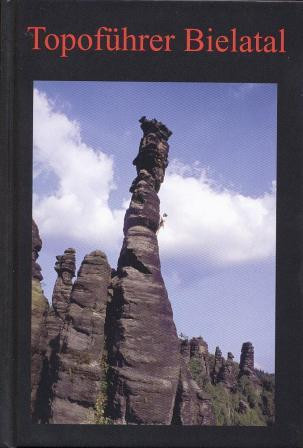
It is around 160 years since the development of climbing in one of Germany's most beautiful low mountain ranges began. In the recent past, several peaks in the Bielatal have been opened up for climbing, which is why a complete climbing guide was long overdue. The present work now contains information on 4,209 ascent descriptions at 249 climbing destinations.The climbing guide is divided into three sectors: North part, middle part and south part. All objects are shown on colored area maps. There is an ascent sketch for each summit, with somewhat confusing walls also shown using topo sketches.The new climbing guide uses a series of pictograms to draw the user's attention to important features of the respective climbing crag: fast-drying rock, child-friendly terrain, often damp, historical information and information on closure periods.In addition to the usual descriptions of the summits and ascents, the reader is provided with a wealth of background information. At the same time, the climbing guide is illustrated with a large number of historical and current photos.312 pagesLanguage GermanEdition 2024M. BellmannHeimatbuchverlag Michael Bellmann
The Bielatal climbing guide is part of the six-volume guide series Saxon Switzerland from the mountain and nature publisher Peter Rölke. This volume describes 249 peaks with 4027 ascents. These climbing destinations are located in the Bielatal. The Bielatal with its peaks is the richest climbing area within Saxon Switzerland. The bizarre rock towers of the valley consist of very solid labiatussandstone, which is strikingly horizontally banded. Thus one has many sharp ledges as footholds and handholds. 4 detailed site plans, on which all peaks are recorded and depicted, help to find the climbing destinations in this region. On 19 climbing sketches 83 peaks are recorded and on 3 topos 4 peaks are shown. Dark blue rubberized cover Area: Saxon Switzerland is a national park around the Elbe valley south-east of Dresden in Saxony Rock: sandstone Difficulties: wide choice of routes in all grades - up to XI (saxon grade) Number of routes: 4027 routes Protection: trad climbing Season: spring, summer, fall
352 pages Language: German edition 2015 Team of Authors Berg- und NaturVerlag Peter Rölke
The climbing guidebook Gebiet der Steine is part of the six-volume guidebook series Sächsische Schweiz from Berg- und NaturVerlag Peter Rölke. The present volume Gebiet der Steine / Erzgebirgsgrenzgebiet describes 126 (16 in the Erzgebirge) climbing peaks and 3 massifs (the exception in the Elbsandstein) with a total of 2826 routes in the Saxon difficulty ratings from 1 to 12. Thus, a field of activity for beginners and extreme climbers. The area of the stones includes the characteristic Tafelberge of Saxon Switzerland as well as many peaks in their near vicinity. They are distributed on both sides of the Elbe River. This volume contains 12 detailed site plans on which all climbing destinations are recorded and depicted. A further 36 climbing sketches and 8 side views illustrate various peaks and massifs, thus facilitating orientation. It also provides an overview of the Saxon climbing rules.
Red-orange rubberized cover 368 pages language german edition 2015 Autorenteam Berg- und NaturVerlag Peter Rölke
Elbsandstein Plaisir - climbing for beginners and plaisir climbers
The Elbe Sandstone Mountains southeast of Dresden are certainly one of the most scenic and best climbing areas in Europe. Bizarre rock towers, romantic gorges, endless forests - even the painters of the Romantic period were fascinated by the rock country to the right and left of the Elbe. A climbing tradition of over 150 years has preserved a rather strict set of rules here: there are only a few belay rings and no metal clamping wedges or friends may be used. But to conclude from this that climbing on the more than thousand towers is poorly secured or even dangerous is wrong. Many of the more than 21,000 climbing routes can be secured excellently with the existing rings and additionally laid slings. In this richly illustrated guide, Helmut Schulze and Valentin Hölker have compiled a selection of over 400 of the most rewarding sandstone routes, mainly in difficulty grades I to VII - with clear topos and important tips on the safety. This is intended to make it easier for pleasure climbers, those unfamiliar with the area, or beginners to get started in Elbe sandstone climbing. Trails are located in the following areas: Bielatal, Rathen, Falkenstein, Schrammsteine, Tafelberge.
464 pages language german edition 2022 + vertical life app H. Schulze & V. Hölker Panico Alpinverlag
We use cookies (including third party cookies) to provide you with the best possible service. Some of them are essential, while others help us to improve this website and your experience of it. You have the right to withdraw your consent at any time. You can find more information on Privacy policy.